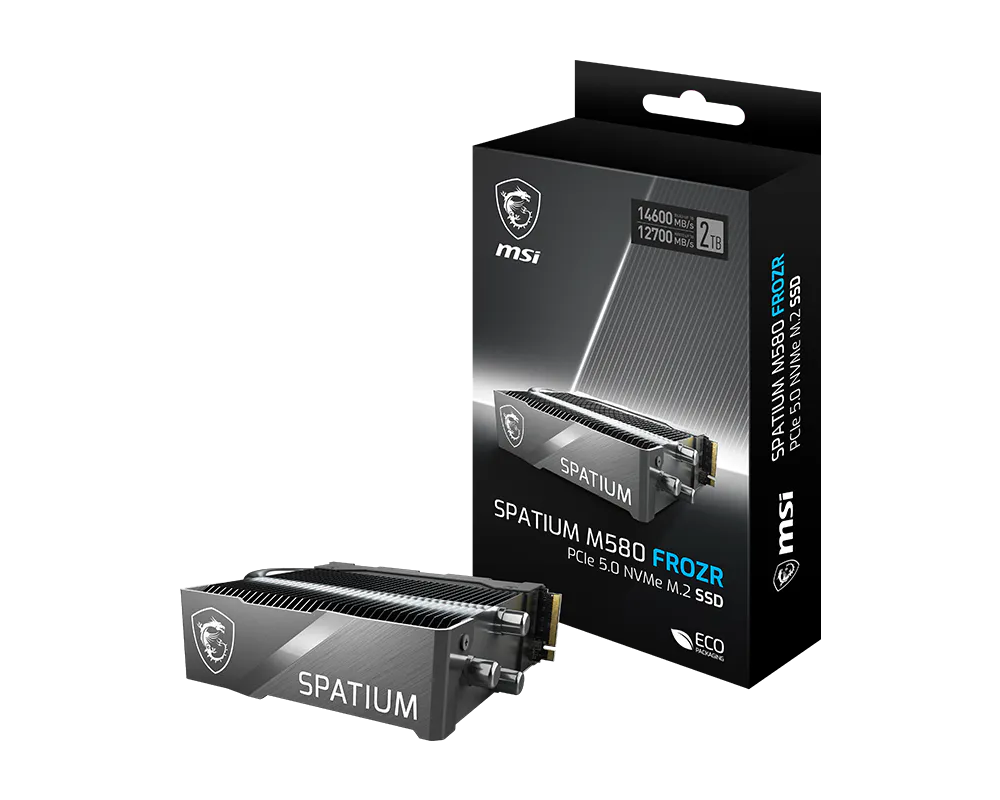
SPATIUM M580 PCIe 5.0 NVMe M.2 FROZR
| Differences are marked in red | SPATIUM M580 PCIe 5.0 NVMe M.2 FROZR 1TB | SPATIUM M580 PCIe 5.0 NVMe M.2 FROZR 2TB | SPATIUM M580 PCIe 5.0 NVMe M.2 FROZR 4TB |
|---|---|---|---|
| Model Name | SPATIUM M580 PCIe 5.0 NVMe M.2 FROZR | SPATIUM M580 PCIe 5.0 NVMe M.2 FROZR | SPATIUM M580 PCIe 5.0 NVMe M.2 FROZR |
| Capacity | 1TB | 2TB | 4TB |
| Controller | PHISON E26 | PHISON E26 | PHISON E26 |
| Flash Memory | 3D NAND | 3D NAND | 3D NAND |
| DRAM Cache | 2GB LPDDR4 | 4GB LPDDR4 | 8GB LPDDR4 |
| Form Factor | M.2 2280 | M.2 2280 | M.2 2280 |
| Interface | PCIe Gen5x4, NVMe 2.0 | PCIe Gen5x4, NVMe 2.0 | PCIe Gen5x4, NVMe 2.0 |
| Compatibility | PCIe Gen5 / Gen4 / Gen3 / Gen2 / Gen1 | PCIe Gen5 / Gen4 / Gen3 / Gen2 / Gen1 | PCIe Gen5 / Gen4 / Gen3 / Gen2 / Gen1 |
| Dimensions | 94.80mm (L) x 24.00mm (W) x 71.65mm (H) | 94.80mm (L) x 24.00mm (W) x 71.65mm (H) | 94.80mm (L) x 24.00mm (W) x 71.65mm (H) |
| Sequential Read up to (MB/s) | 13,700 | 14,600 | 14,100 |
| Sequential Write up to (MB/s) | 10,300 | 12,700 | 12,600 |
| Maximum Operating Power (W) | 11.5 | 11.5 | 11.5 |
| Idle Power PS3 (mW) | 144 | 144 | 144 |
| Low Power L1.2 (mW) | 85 | 85 | 85 |
| Operating Temperatures | 0°C – 70°C | 0°C – 70°C | 0°C – 70°C |
| Storage Temperatures | -40°C – 85°C | -40°C – 85°C | -40°C – 85°C |
| Terabytes Written (TBW) | 700 | 1400 | 3000 |
| Mean Time Between Failure (MTBF) | Up to 1,600,000 Hours | Up to 1,600,000 Hours | Up to 1,600,000 Hours |
| Limited Warranty | 5 Years, or the coverage for the maximum TBW as stated, whichever comes first. | 5 Years, or the coverage for the maximum TBW as stated, whichever comes first. | 5 Years, or the coverage for the maximum TBW as stated, whichever comes first. |
| Advanced Features | TRIM (Performance Optimization, OS Support required)<br /> SMART (Self-Monitoring, Analysis and Reporting Technology)<br /> LDPC (Low Density Parity Check) ECC Algorithm<br /> End to End Data Path Protection<br /> APST (Autonomous Power State Transition)<br /> AES256/OPAL 2.0 (Encryption, Data Security) | TRIM (Performance Optimization, OS Support required)<br /> SMART (Self-Monitoring, Analysis and Reporting Technology)<br /> LDPC (Low Density Parity Check) ECC Algorithm<br /> End to End Data Path Protection<br /> APST (Autonomous Power State Transition)<br /> AES256/OPAL 2.0 (Encryption, Data Security) | TRIM (Performance Optimization, OS Support required)<br /> SMART (Self-Monitoring, Analysis and Reporting Technology)<br /> LDPC (Low Density Parity Check) ECC Algorithm<br /> End to End Data Path Protection<br /> APST (Autonomous Power State Transition)<br /> AES256/OPAL 2.0 (Encryption, Data Security) |
Semua gambar dan deskripsi hanya sebagai ilustrasi saja. Spesifikasi poduk, fungsi, dan tampilan dapat berbeda bedasar CPU dan Chipset yang berbeda. Untuk spesifikasi yang lebih detil, silahkan periksa halaman spesifikasi produk.